As of September 13, the Arc Institute Virtual Cell Challenge 2026 leaderboard reads: Team 42, rank 106 of 933 teams. The task is simple to say and hard to do: silence one gene in a cell and predict what the whole cell does next, in cell lines nobody has ever seen perturbed. This note is about what our number means, the first study we can share, and the road to November.
Team 42 is Linhui Xie, Yurui Chen, Yuxuan Hu, and me. What we are building stays with us until the race ends. What we have learned along the way is worth sharing now.
The ask, in numbers
Teams receive three mystery cell lines. For each one they get 18,400 unperturbed control cells and nothing else. No examples of how these cells respond to any perturbation, in any dataset, anywhere. From that, they must predict the full expression profile for 300 gene knockdowns in each cell line. Multiplied out, one complete entry is 6.7 billion predicted numbers.
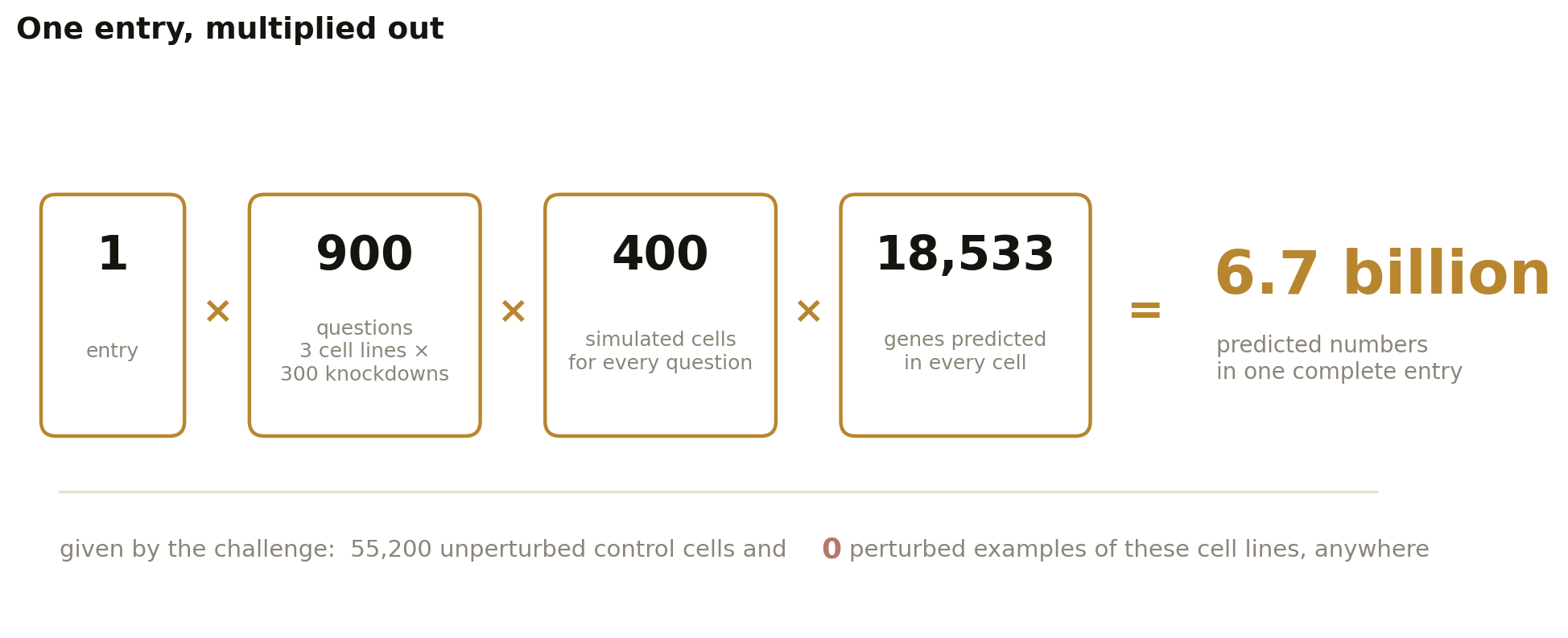 One complete entry, multiplied out. The zero at the bottom is the design choice that defines this year’s edition.
What changed since 2025
Both editions use a 300-gene panel. In 2025 everything happened inside one cell line, H1 stem cells: 150 knockdown responses were given as training, 50 were predicted for the leaderboard, and 100 decided the final. In 2026 the scored cell lines come with zero measured responses, the questions multiply to 900, and the final moves to three further cell lines nobody has seen at all. The same knockdown measured in two different cell lines only barely agrees, so the transferable signal is thin, and finding it is the whole game. The two leaderboards are not comparable, and that is the point of the redesign.
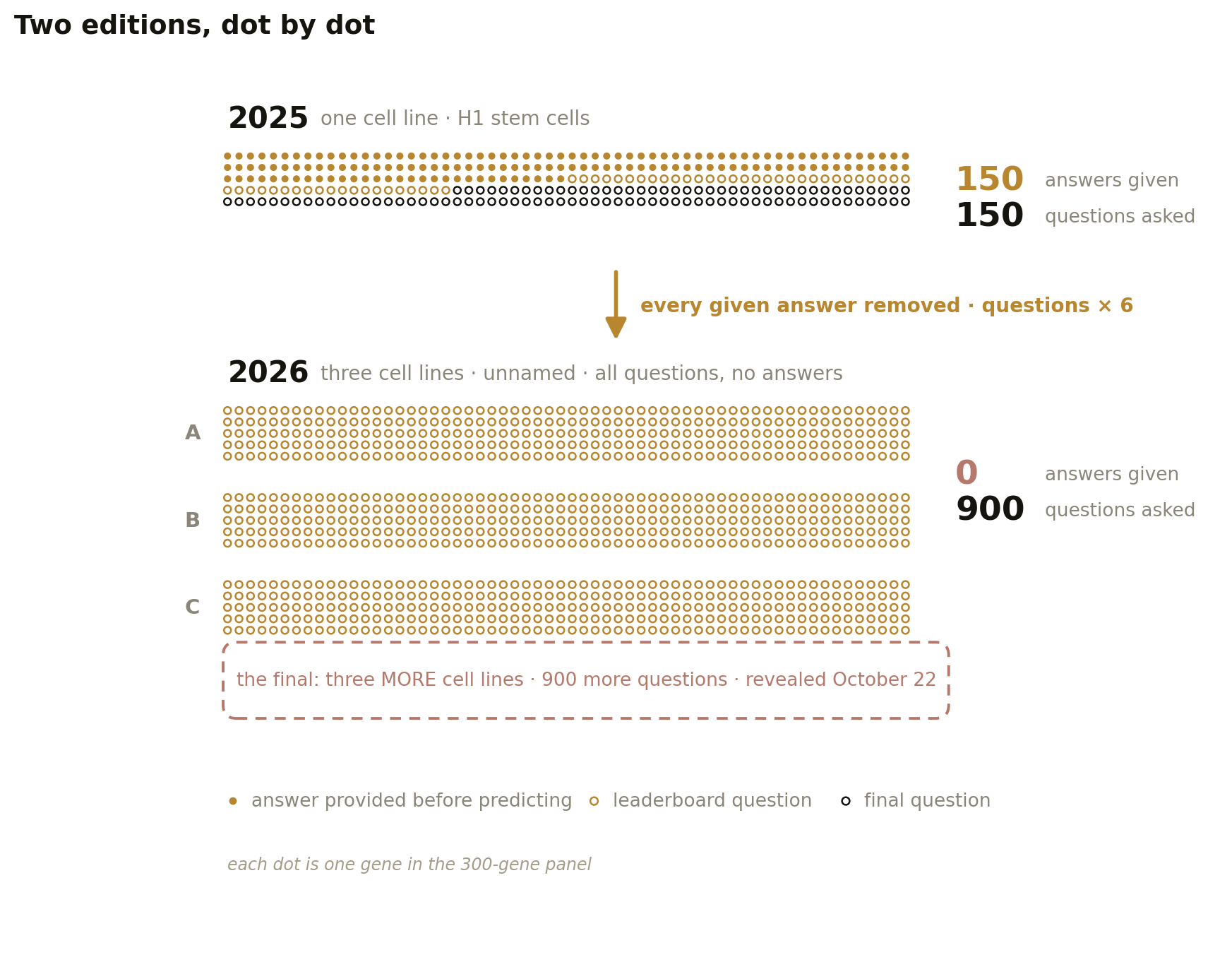 Every dot is one gene in the panel. In 2025 half the panel came with answers. In 2026 none of it does, and there is three times as much of it.
Where we stand
Every entry is scored between two anchors. Zero means no better than giving one average answer for every question. One means matching a rerun of the real experiment. As of September 13, we score 0.1511 and the top team scores 0.2629. No team we can see is anywhere close to one. Studies published last year found that deep learning models on this problem often fail to beat simple linear baselines, and the leaderboard agrees. The whole field, the largest models included, is still far from the center. That is not a reason to stay out. It is the reason the problem deserves the effort.
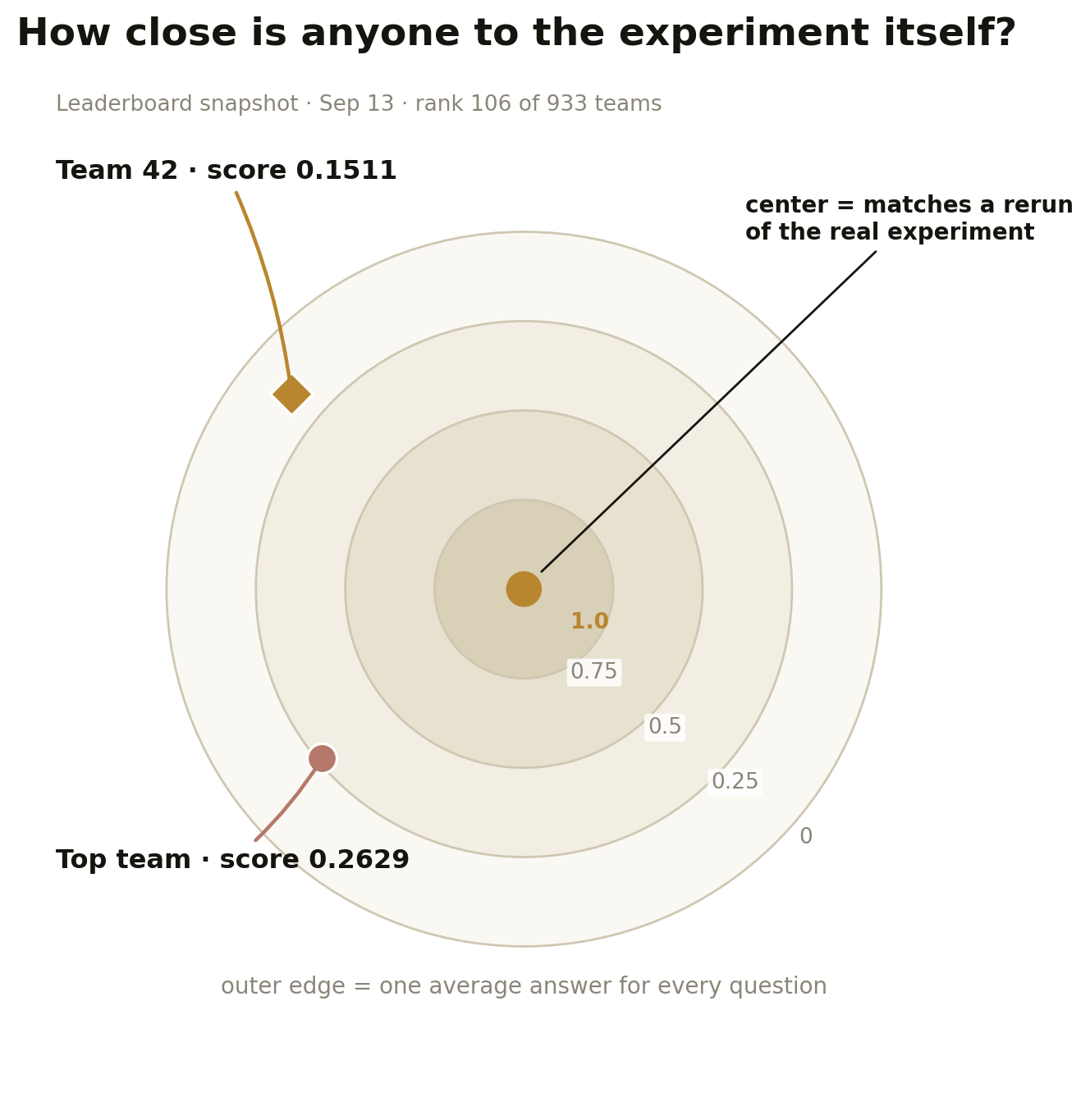
The center is a rerun of the experiment. The outer edge is one average answer for everything. The whole field, us included, is still near the edge.
Naming the mystery cells
Before any modeling, we profiled the 55,200 control cells. The three contexts are three different cell lines, not three batches of one: their cells never mix in a joint embedding, and between contexts expression correlates at 0.75 to 0.84 while a context agrees with itself at 0.9999. We matched each context against 2,098 reference profiles from three independent panels and named all three lines, then verified the calls with checks that never use gene identity, such as chromosome-arm copy number patterns and hallmark gene deletions. One line is confirmed by six independent checks. For another, the lineage is certain but the exact line has weaker support, and we say so.
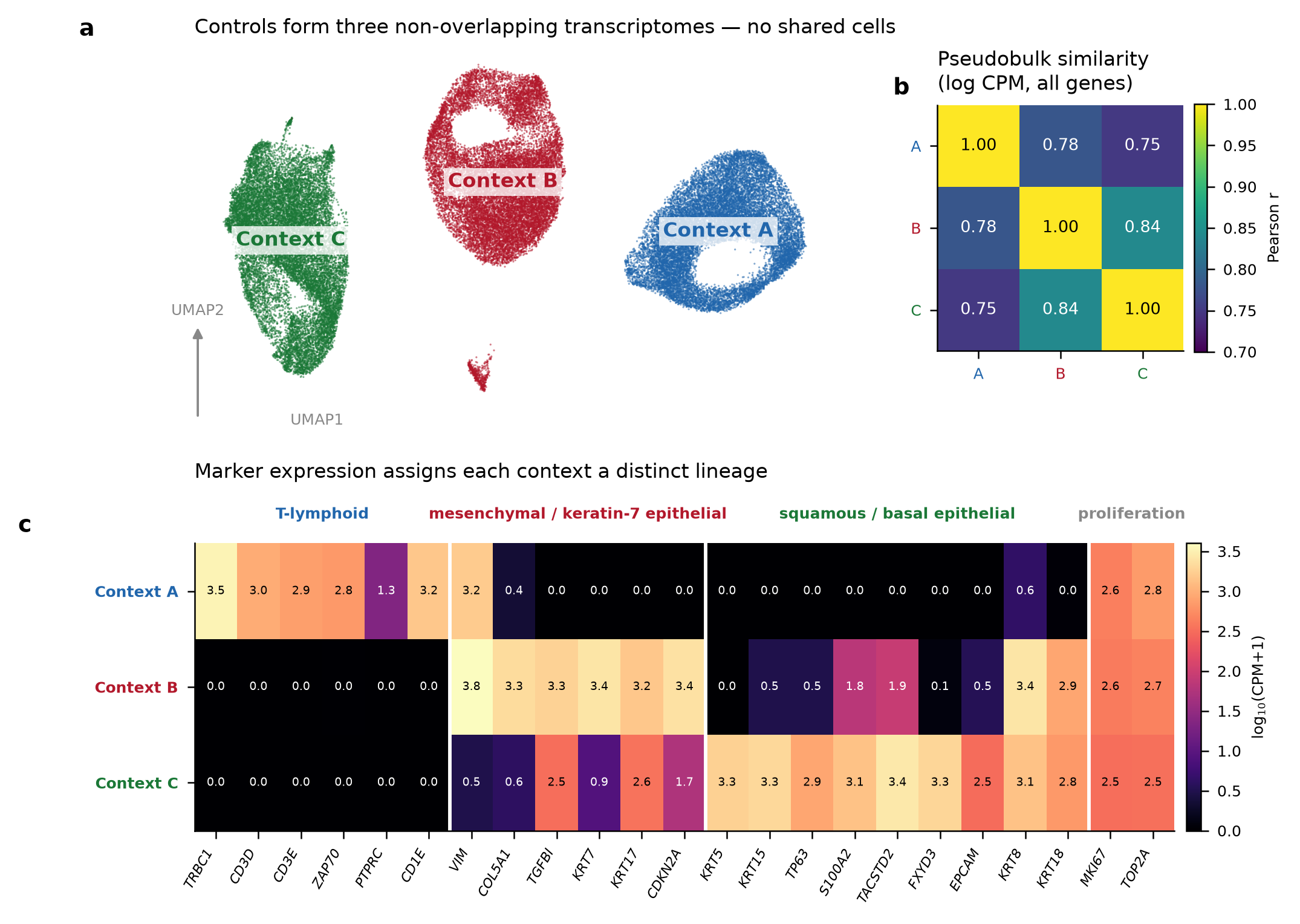 Three non-overlapping populations, three distinct lineages.
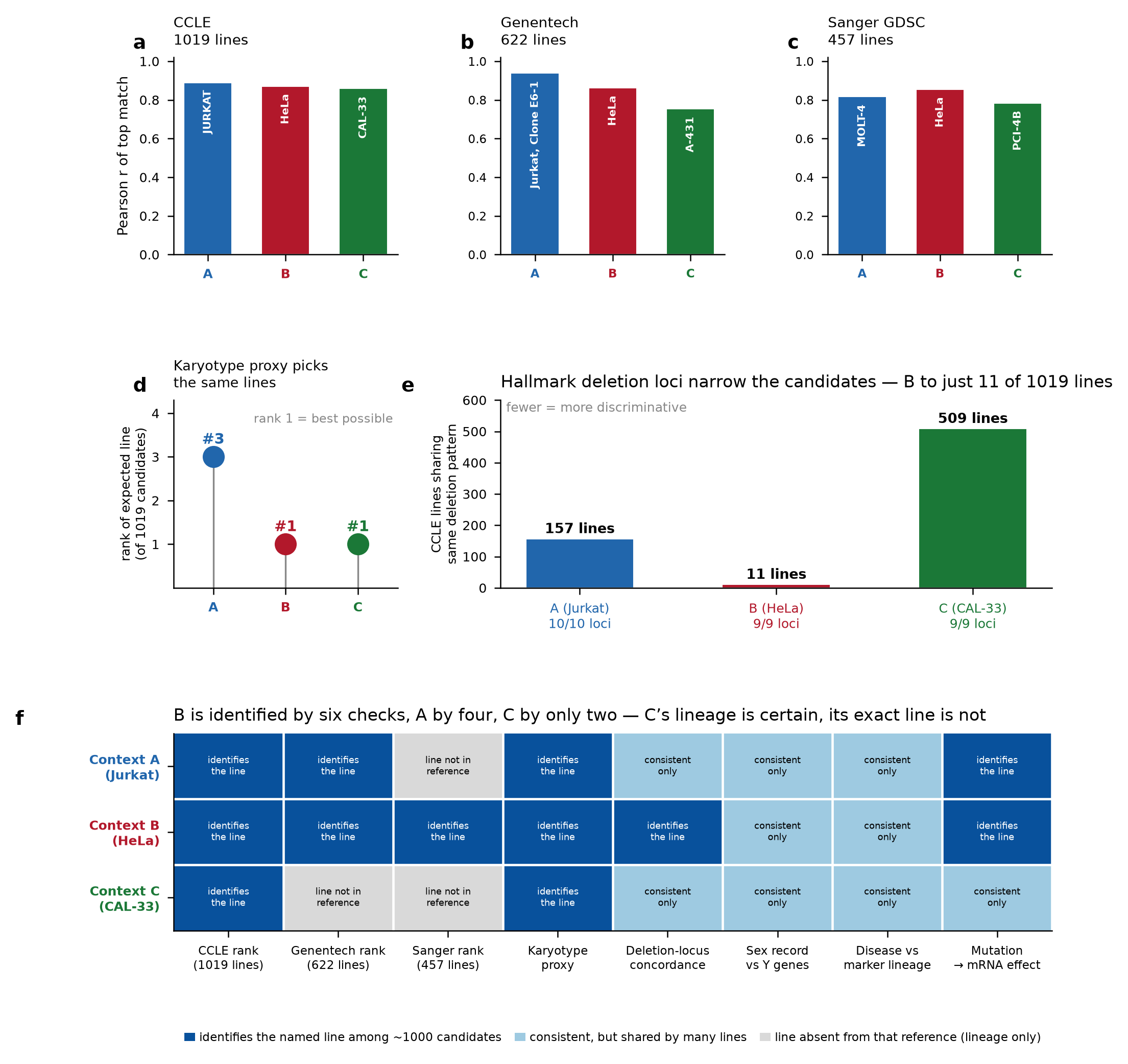 Each call stress-tested with checks that ignore gene identity. The matrix records where a check identifies the line and where it is only consistent.
Two warnings for other teams. The gene panel is pre-filtered, so ordinary quality signals such as ribosomal genes are missing. And the gene names follow an older convention, so joining to a modern reference can silently drop features.
What we hold onto, and what is next
Three habits the challenge rewards, in one breath: predictions are populations, so thousands of identical cells score worse than predicting nothing; only the real evaluation counts, so every conclusion we keep is one the leaderboard confirmed; and characterize before you model, because the naming study changed how we read everything after it.
The public leaderboard runs through October 22. Then the three final cell lines are released, entries close November 5, and the official ranking comes from those alone. We will write the post-mortem either way.
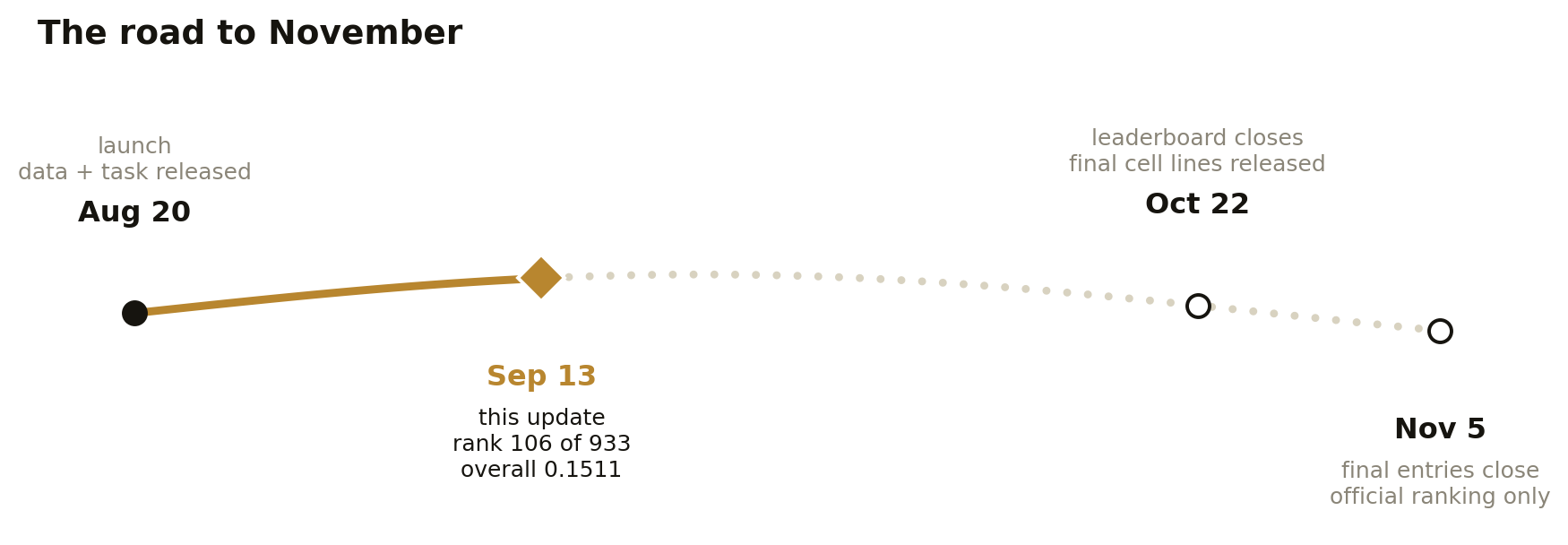
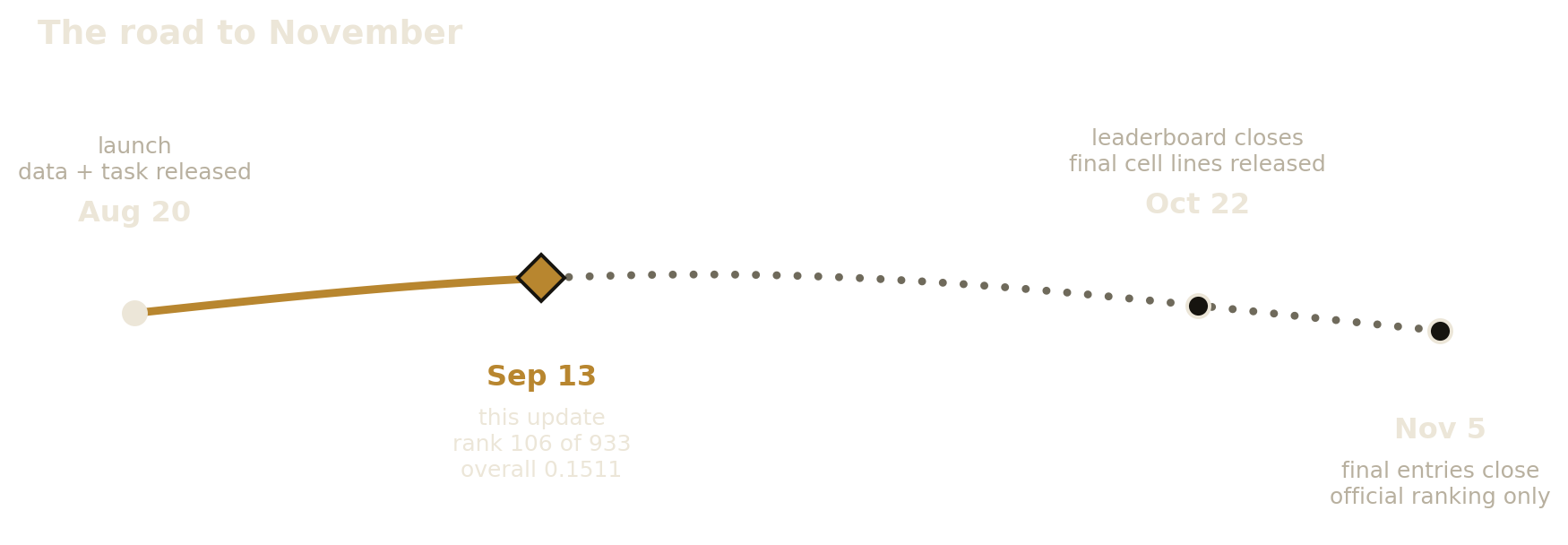
The solid part of the road is behind us. Everything that decides the official ranking is still ahead.